Blogs
« The smartphone has revolutionized the means of communication today and has become an essential tool in the daily life of the French. Indeed, more than 64.70 million French people are equipped with smartphones, and the frequency of mobile app downloads is constantly increasing. That is why it is necessary to explore the latest technologies available to design and develop an iOS and Android mobile application. »
Native applications:
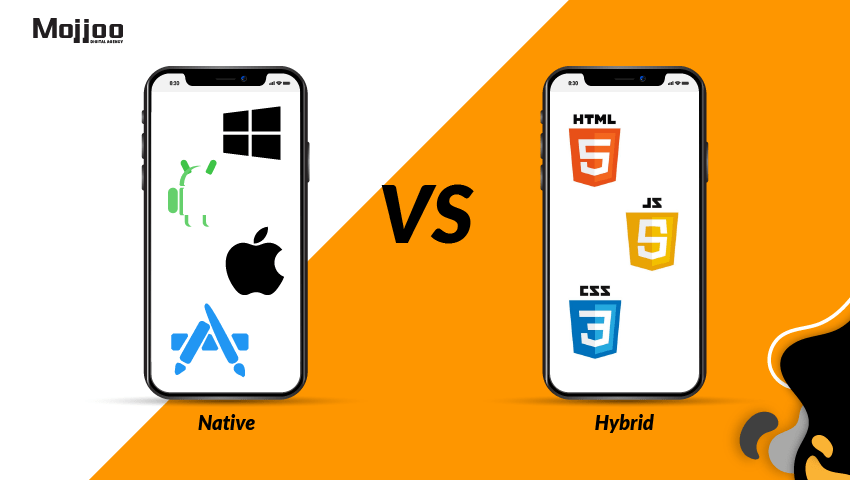
The majority of downloaded apps found on a mobile device are native applications. These are applications specifically designed for the operating systems used by smartphones and tablets. Android and iOS are currently considered the most well-known operating systems. The first is developed by Google Play using the Kotlin programming language (Android Java), and the second, Apple products, use the Swift programming language (Objective C).
Native applications are characterized by their speed, smoothness, and performance in terms of usability and functionality. They are intended for complex projects because they allow for a custom-built application tailored to each smartphone model, both in design and navigation, with record response times. The main advantage of native applications lies in the ability to implement push notifications — an ideal feature that allows you to optimize your marketing and commercial strategy.
Native applications require significant investment; if you choose this format, you need to develop two versions of the application in the programming language required by each platform to target both iOS and Android users. In the case of an update, this also increases maintenance costs.
Hybrid applications:
The new hybrid app development solution emerged to address constraints related to the lack of expert workforce in native mobile development and to minimize the cost of developing a mobile application. Indeed, a hybrid application can be deployed across various operating systems using common web technologies (HTML, HTML5, CSS, JavaScript) that work on all platforms, including iOS, Android, and Windows Phone.
Compared to native applications, a hybrid app is less expensive to develop, and future updates are easier to manage since the source code remains unique to create an app simultaneously for Android and iOS. Thus, the web app code can be reused because it is generally written once and then deployed across all mobile platforms.
However, hybrid applications have some disadvantages, such as lower performance compared to native apps, especially regarding responsiveness. Navigation between interfaces is less smooth, which affects the user experience, making this solution mainly suitable for mobile apps with simple functionalities.
So, which technology should you choose for your mobile application?
The choice between a native or hybrid mobile application depends on many factors you should consider, such as your budget, your needs, your goals, your expectations, etc.
We recommend first identifying the main lines of your mobile project. Moreover, when the specifications are precise, the choice between these two solutions becomes clear and easy to make.
In summary, native applications are responsive, high-performing, and offer a better user experience. Whether iOS or Android, a native app is accessible, secure, and provides optimal navigation but is more costly because it requires development in two programming languages: Swift and Java.
On the other hand, a hybrid application allows the development of a single solution for both Android and iOS, reducing development costs. Additionally, it is easy to code and well-suited to the current mobile app market. However, hybrid apps do not account for the particularities of each platform. Therefore, the user experience remains basic.
If you want to launch and develop your mobile application but still don’t know where to start, don’t wait any longer — tell us about your mobile app project. Our marketing managers and developers will advise you on making the right choice and guide you through the complete development of your mobile application from A to Z.
You can also discover the latest mobile application we designed and developed for our client Mercedes-Benz.
iOS version: http://bit.ly/3dMJ0al
Android version: https://bit.ly/2EC21R7
Recent Articles

E-commerce Bounce Rate: How to Retain Your Visitors?
Bounce Rate in E-commerce: How to Keep Your Visitors? One key factor to track is...
What is Growth Marketing?
What is GROWTH MARKETING? It’s a modern approach to attract, engage, and retain customers over...

How to Run a Successful Branding Campaign?
A branding campaign involves marketing actions taken by a company to get noticed, reach a...